
Releases Through RRM San Antonio
RRM San Antonio manages federal community placement relationships across its region. The field office at 727 East César E. Chávez Boulevard, Suite B-138, is not itself a prison holding every person whose record mentions the office. Contract residential reentry centers, community placement, and home confinement can fall within its administrative work.
Movement out of a secure prison to a residential reentry center does not necessarily end BOP custody. Home confinement can also remain BOP custody. Actual completion of the federal custodial term is a different milestone, after which the locator commonly shows a release date and indicates that the person is released or no longer in BOP custody.
Federal supervised release can continue after BOP custody ends. The sentencing judgment and U.S. Probation record explain that court-ordered period. A locator result should therefore be described as a BOP custody status, not a statement that every legal obligation ended.
Confirm an RRM San Antonio Release
- Open the BOP Inmate Locator.
- Search by BOP register, DCDC, FBI, or INS number when available. Otherwise use exact name with optional age, race, and sex.
- Match the register number and biographical details. Do not rely on name alone.
- Read the location and release-date fields together. An RRC or home-confinement placement can remain BOP custody.
- Check the federal court judgment and docket for sentence, release conditions, and later orders.
- If the person does not appear or older detail is needed, submit a BOP FOIA request for existing custody and release history.
The BCSO daily CSV does not cover an RRM-managed federal placement unless the person also had a separate Bexar County booking. The Bexar County released inmates page explains how to preserve those episodes separately.
RRM San Antonio Records and Contact
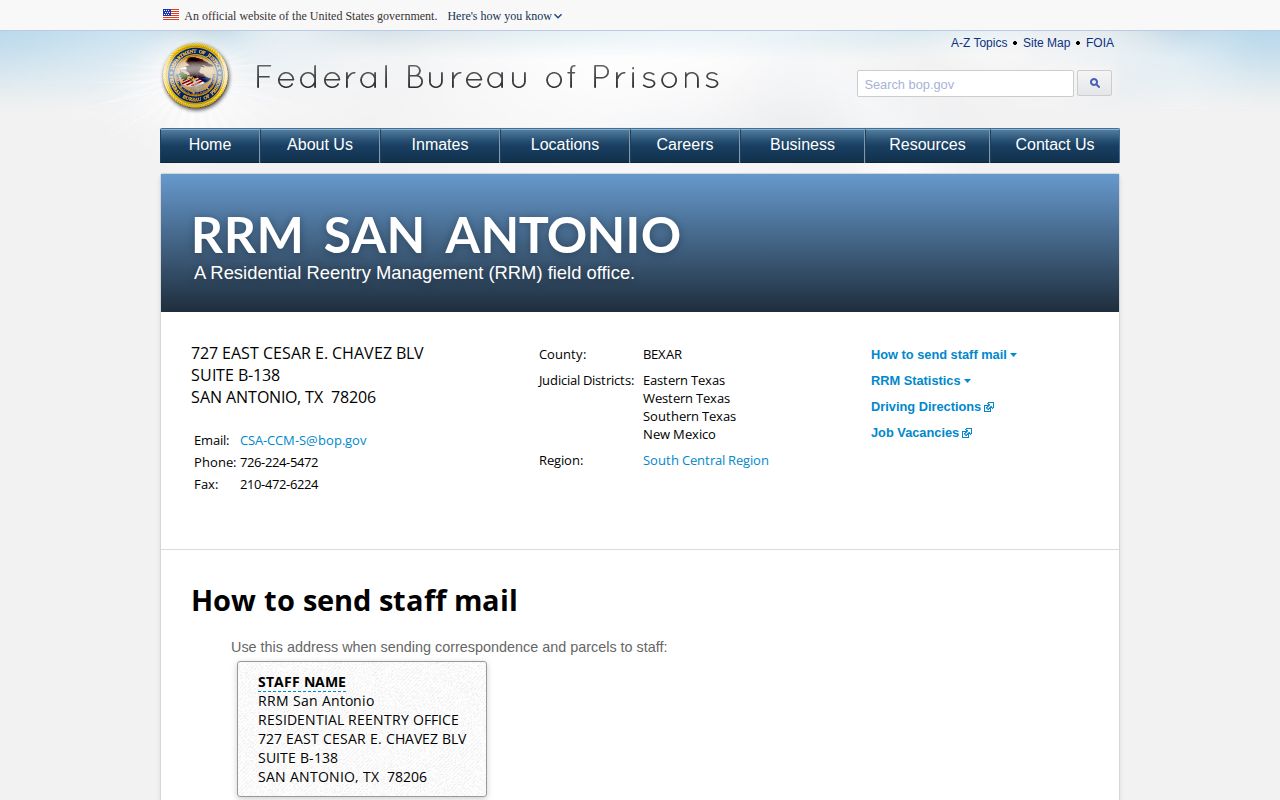
RRM San Antonio
727 East César E. Chávez Boulevard, Suite B-138
San Antonio, TX
BOP Residential Reentry Management field office
The official BOP location page is the source for the office identity and address.
For historical custody records, use BOP FOIA. Provide the full name, register number, date of birth, approximate dates, and the specific release, transfer, RRC, or home-confinement records requested. For judicial facts, obtain the federal docket separately. The office should not be asked to interpret a sentence or offer a hypothetical date.
About the BOP Field Office
No BOP-operated prison in Bexar County was identified in the official directory. RRM San Antonio administers community-corrections relationships and should not be described as a jail simply because a locator location is associated with it. The actual residential placement may be elsewhere within the region.
Central Texas Detention Facility is a distinct downtown contract detention site with documented USMS use. A federal pretrial detainee there may not yet appear in BOP's locator. ICE/ERO is also separate. Each system has its own custodian, locator limits, and records process.
This distinction prevents a common error: assuming that any federal record tied to San Antonio belongs to one building. The docket, register number, location field, and agency record establish the chain. Confirm the named placement and responsible office on the date of inquiry because contracts, locations, and custody assignments can change.
Read BOP Locator Results Carefully
BOP's locator covers federal inmates from 1982 to the present. Results can show name, register number, age, race, sex, release date, and location. A result marked “Released” or “Not in BOP Custody” confirms only that BOP does not currently hold the person. BOP warns that another correctional system may hold the person.
The official locator shows the released-result path.
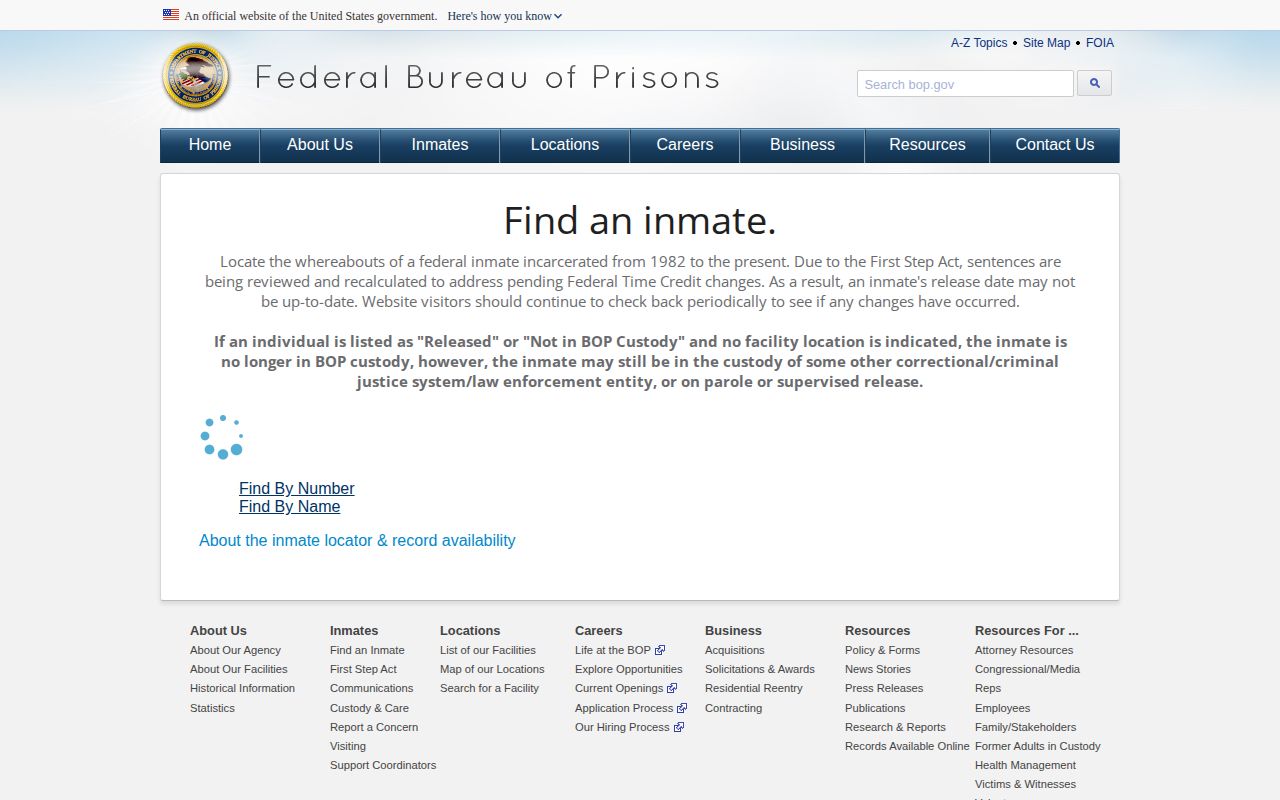
BOP also cautions that some release dates can lag First Step Act recalculation. Save the date the result was checked. A later official calculation can supersede an earlier display without making the earlier observation dishonest.
RRC and Home Confinement Are Custody
RRM oversight can continue across several physical settings. A person may move from a secure BOP institution to a contracted residential reentry center and later to home confinement while remaining within the federal custodial term. The public-facing address for RRM San Antonio identifies the administrative field office, not necessarily the residence, contract provider, or daily reporting point assigned to a particular person. Location questions should be answered from the current BOP record and direct official confirmation rather than from the field-office address alone.
The federal judgment supplies the sentence, while BOP administers the custodial portion. A later term of supervised release belongs to the federal court and U.S. Probation. These records can overlap in time only at transition points, and they should not be collapsed into one generic supervision label. The locator's release date is evidence about BOP custody. The judgment and docket establish whether supervised release follows and whether the court later modifies or revokes it.
Historical confirmation follows the same division of responsibility. BOP FOIA can seek institution assignments, transfers, community placement, home-confinement status, and the actual BOP release date. The federal docket supplies judicial orders. USMS records matter when the person was held before trial or transported before BOP designation. If Bexar County jail transferred the person to federal custody, the BCSO row establishes the county exit but not completion of the federal term. Keeping each custodian's record separate produces a reliable sequence from local release, through federal custody, to any later community supervision.
BOP warns that “Not in BOP Custody” does not exclude custody by another correctional authority. It also cautions that some displayed dates may lag recalculation under federal law. Save the date of the locator check, match the register number, and verify a changed result through the agency record. This is especially important when a name search returns more than one plausible person.
A residential reentry center can provide structured community placement near the end of a federal sentence. Home confinement moves the person out of a prison building but can remain under BOP authority. Neither should automatically be labeled completed release from BOP custody.
Use the location field, case record, and BOP response to state the narrow fact supported: transfer to community placement, home confinement, release from BOP, or commencement of supervised release. If the exact transition is unclear, avoid substituting an estimate based on physical location.
Does living outside a prison prove release? No. Custody is a legal and administrative status, not merely the kind of building where someone sleeps.
When Bexar and Federal Records Overlap
A person may leave Bexar County jail under a federal transfer. The county row establishes the end of local custody, while the BOP or USMS record establishes continued federal custody. Record both events and their dates. Do not say the person entered the community unless the receiving record supports it.
A USMS transfer before BOP designation may create a gap in the public BOP locator. Use the federal docket, counsel, responsible Marshals district, and facility confirmation. If designation later occurs, compare the BOP register number with the case.
An ICE detainer can also redirect departure. ICE asks for notice and up to 48 additional hours so DHS may assume custody. That path belongs in ICE's locator and records system, not RRM San Antonio.
Federal Supervision After BOP Release
Supervised release is ordered by the federal court and administered through U.S. Probation. It is not BOP incarceration, even though it can follow a BOP release date. The judgment states the term and conditions, and later docket entries can show modification or revocation proceedings.
Do not confuse federal supervised release with Texas parole or Bexar County probation. TDCJ Parole Division supervises Texas parole and mandatory supervision. Bexar CSCD supervises county community supervision. The office named in the judgment determines the correct route.
A completed BOP term and a continuing supervision term can therefore appear together without conflict. Use the locator to answer whether BOP holds the person, the judgment to identify the ordered supervision period, and the docket for later court action. If a new arrest or revocation occurs, date that later event instead of rewriting the earlier BOP release as though it never happened.
Notification systems also follow agency boundaries. Texas IVSS-Counties covers county jail and court events, and TDCJ IVSS covers Texas prison and parole matters. Neither is the federal notification or status channel for an RRM-managed placement.
Get an RRM San Antonio Release Record
Start with the locator result and federal docket. For a durable agency history, ask BOP for records showing institution or RRC placement, transfers, home-confinement status where applicable, and actual release date. Request existing fields rather than asking BOP to form a legal opinion.
Include the register number whenever possible. If unknown, provide full name, date of birth, and case details. Similar names can produce an incorrect match, while the register number follows the federal record.
Preserve the distinction among a prison departure, an RRC placement, home confinement, release from BOP custody, and supervised release. Those milestones can occur in sequence, and each answers a different question.