
Parole vs Probation in Bexar County
Three local statuses are often confused. The Texas Board of Pardons and Paroles decides parole and mandatory-supervision matters. The TDCJ Parole Division supervises people serving the balance of a prison sentence in the community, but it does not make the release decision, revoke parole, or impose special conditions. Bexar County Community Supervision and Corrections Department, or CSCD, supervises court-ordered community supervision commonly called probation. Bexar Pretrial Services handles some people released on bond while a criminal case remains pending.
| Status | Decision maker | Supervising office | Best verification record |
|---|---|---|---|
| Parole or mandatory supervision | Texas BPP | TDCJ Parole Division | BPP status plus assigned district office |
| Probation | Sentencing court | Bexar County CSCD | Court docket, judgment, and CSCD |
| Pretrial release | Magistrate or court | Bexar Pretrial Services when ordered | Bond order, court docket, and Pretrial Services |
A Bexar jail release row records the end of that county custody episode. It does not by itself identify later parole or probation supervision. Likewise, an active supervision record does not replace the actual release timestamp or court disposition.
How to Verify Bexar County Post-Release Supervision
- Identify the originating custody. Use the BCSO dated release report for county jail, TDCJ records for state prison, and the court docket for probation or bond.
- Read the disposition. The Bexar Justice Information Portal can connect the name or case number to a judgment, sentence, bond order, or later warrant.
- For parole, check the decision channel. Call the BPP Parole Status Line at 844-512-0461 with the name, TDCJ-CID number, and date of birth. A favorable vote is not a physical-release record.
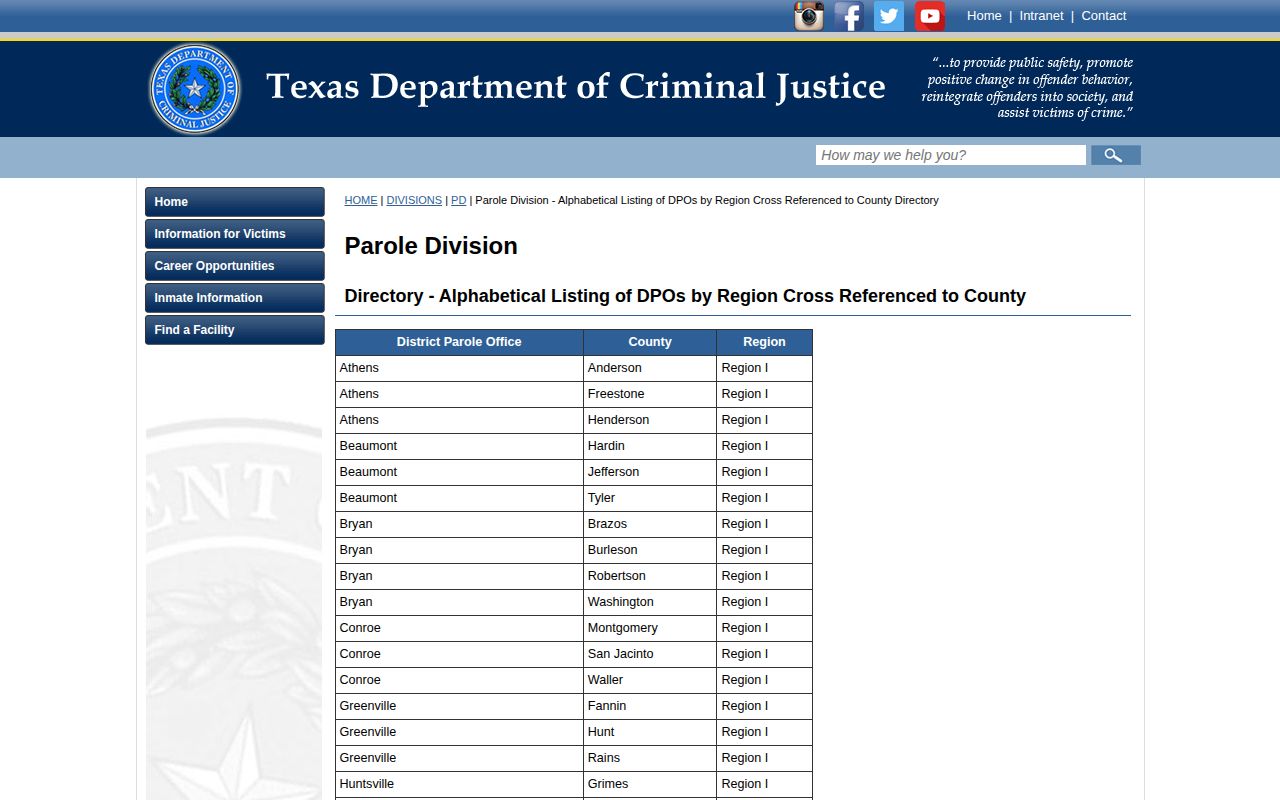
- Find the reporting office. Use the TDCJ county-to-office map. Bexar County is served by several Region IV San Antonio offices, so do not assume the Board office is the reporting location.
- For probation, start with the sentencing court. Confirm the judgment and then contact Bexar CSCD. No statewide public probationer locator was found.
- Date each answer. A release, later violation allegation, warrant, discharge, and new custody event can all be true at different times.
Can the current TDCJ inmate search verify a parolee? Not reliably after release. The public portal is limited to people currently incarcerated in a TDCJ facility and is updated on working days with information at least 24 hours old. For historical release or discharge information, email pia@tdcj.texas.gov with identifying information and ask for the actual date and mechanism.
San Antonio Parole and Probation Offices
The Region IV directory lists San Antonio I at the Metro Parole Complex, 2902 NE Loop 410, San Antonio, TX 78218, 210-564-3700. San Antonio II is at 2821 Guadalupe Street, Suite 106, San Antonio, TX 78207, 210-436-5885. San Antonio III and the District Reentry Center share the Metro complex address and 210-564-3700 number. Assignment, not convenience, determines where someone reports.
Bexar County CSCD
207 North Comal Street
San Antonio, TX 78207
210-335-7200
Monday through Friday, 8 a.m. to 5 p.m.
The San Antonio Board Office at 85 NE Loop 410, Suite 112, 210-342-2012, is a decision office. Its correspondence address is SABoardCorrespondence@tdcj.texas.gov. It should not be described as the routine reporting office simply because its panel voted on a case.
The official TDCJ parole office directory shows how local assignments are organized.
No Ordinary Texas Parole Hearing Calendar
Ordinary Texas parole review is a file-review process rather than a public courtroom-style hearing. An institutional parole officer develops the case summary before the panel considers it, and the three panel members vote in sequence. Two matching votes establish the decision. This structure explains why searching for a Bexar County hearing date or public daily calendar does not produce the expected result. The useful official channels are the review-status line, the assigned Board office, victim notification when applicable, and the written decision sent to the person under review.
Timing also depends on whether the case is approaching initial eligibility or a later review. The Parole Division generally identifies an initial case about six months before eligibility and a later-review case about four months before the scheduled review. Those preparation periods are not promised release dates. If parole is denied, the correspondence supplies the next review date. If the vote is favorable, conditions, required programming, a suitable release plan, detainers, and administrative processing can remain. A vote code should therefore be recorded with its date and decoded through the official BPP glossary before anyone describes the likely next step.
Government Code sections 508.145 and 508.149 govern major eligibility and mandatory-supervision questions. Eligibility only opens the Board's authority to consider release. It does not compel a favorable vote. Offense date, offense category, deadly-weapon findings, sentence structure, and statutory exclusions can affect the route. For a released person whose current TDCJ search result has disappeared, the historical TDCJ record and BPP status channels provide stronger evidence than an old projected date.
Texas does not hold a formal public hearing for ordinary parole or mandatory-release consideration. Board panel members review and vote a file individually, so there is no statewide person-by-person public calendar or regular hearing cadence to search. Registered victims may receive notice of upcoming review. Revocation hearings are distinct administrative proceedings.
The Parole Division identifies a case about six months before initial eligibility and about four months before a later review. An institutional parole officer prepares the case summary. Three panel members vote sequentially, and two matching votes decide the result. A denial notice supplies a next-review date.
The BPP vote-options glossary explains results. FI variants are favorable and may require a program or condition. RMS concerns mandatory supervision. NR gives a later review month and year. SA means serve all, subject to any legally earlier mandatory-supervision consideration, while DMS denies mandatory supervision and can set later review. None of these codes should be converted into an invented departure date.
Bexar County Warrants and Absconder Status
TDCJ defines an absconder as a supervised person who stopped reporting and whose location is unknown. The Parole Division anonymous tip line, 866-680-6667, operates around the clock, but it is not a public name list or an ordinary verification line. No county-published parole or probation absconder roster was located.
BCSO warrant and detainer information is available at 210-335-6030 or 210-335-6050, Monday through Friday from 8 a.m. to 5 p.m. The court portal can also reveal warrants tied to a case. A later warrant does not erase an earlier release. Record the date of the release and the date of any later status separately.
Notification tools have separate scope. Texas IVSS-Counties covers Bexar jail and court custody events, while TDCJ IVSS covers state prison, parole, and mandatory supervision. Neither is a substitute for an official supervision record.
Pretrial Release Is Not Parole
Bexar Pretrial Services at 222 South Comal, Suite 124, supervises eligible people released on personal-recognizance or conditional surety bonds while cases remain pending. The main number is 210-335-8964, and GPS release questions use 210-335-8962. Listed weekday hours are 8 a.m. to 5 p.m.; the after-hours and weekend line is 210-335-1371.
A bond condition comes from a pending case, not a completed prison sentence. Confirm it with the bond order, the Bexar court docket, and Pretrial Services. Do not send someone to CSCD or a TDCJ office merely because all three systems involve community conditions.
Reentry Help After a Bexar County Release
The county-operated Reentry Center at 222 South Comal sits near the justice complex. It offers navigation for identification recovery, food, hygiene supplies, clothing, benefits, behavioral-health support, utilities, education, and Cite & Release needs. The county directory lists 210-335-8281, while the detailed services page also prints 210-335-8744. Because both appear in official county material, use the directory number as the initial route and keep the second number as a documented alternative.
These services do not determine supervision status. They address practical needs that can affect a safe transition and the ability to comply with instructions. Reporting requirements should still be confirmed with the assigned officer or court.
Recovering Property After Bexar Release
Property follows the custody path. A person transferred to TDCJ or another facility uses the receiving system's clothing and trust-account channels. Someone released into the community may need the BCSO or SAPD property room for evidence or safekeeping items.
The BCSO Property Room requires an appointment, case number, identification, and sometimes an investigator release or court order. The retained property receipt can corroborate which agency held the property and when the custody episode ended. Texas retention schedules generally keep prisoner property inventories and receipts for release or transfer plus two years, although an expunction order can override ordinary retention.
How Bexar County Supervision Ends
Parole or mandatory supervision ends through the TDCJ process governing the sentence, while probation ends through the sentencing court and CSCD record. A maximum-expiration date, discharge entry, court order, and closing supervision notation answer different parts of the question. Request the existing record from the agency that owns it rather than asking another office to infer the result.
For a former state prisoner, TDCJ's no-charge email channel can provide incarceration history and an actual release or discharge date when sufficient identifiers are supplied, though it does not promise every historical field. For county probation, obtain the judgment and later orders from the proper Bexar clerk and verify the case with CSCD. The release record workflow on the Bexar County released inmates home page explains how custody evidence and court evidence fit together.