
Check a Bexar County Projected Release Date
- Determine whether the person is in the Bexar County jail, a TDCJ unit such as Dominguez, federal custody, or another system.
- For a current TDCJ prisoner, open the TDCJ Online Offender Search.
- Search by TDCJ or SID number when known. Otherwise use exact last name and at least a first initial, with gender and race filters if helpful.
- Compare name, identifiers, county, court, offense, sentence, current unit, and dates before treating the result as the correct person.
- Read “Projected Release Date” and “Parole Review Information” as separate fields. Neither is an actual departure timestamp.
- Confirm later changes through TDCJ, BPP, or the actual release record.
The portal includes only people currently incarcerated in a TDCJ facility. It is updated on working days, and TDCJ says information is at least 24 hours old. Once someone leaves state prison, the record ordinarily disappears from this current-only search.
What the TDCJ Date Means
TDCJ determines the Projected Release Date from the offense date and nature of the offense. For an eligible offense before September 1, 1996, a person not paroled is released on the projected date under the former mandatory-supervision structure. For an offense on or after that date, mandatory supervision is discretionary and requires Board approval. If approval is denied, or the offense is not eligible, TDCJ describes the projected date as the discharge date.
The official TDCJ inmate-information page defines the projected date and explains the available email record fields. Its current-record limitations are essential when interpreting the number.
Texas Good Time Does Not Shorten Every Sentence
Texas Government Code section 498.003 governs good-conduct classification and accrual, while section 498.004 governs forfeiture and restoration. The official Parole in Texas manual says good time rewards conduct and qualifying participation. For many, but not all, prisoners it combines with calendar time to calculate parole or mandatory-supervision eligibility.
Good time does not otherwise reduce the judicial sentence. It is a privilege, not a right, and can be forfeited. The Board of Pardons and Paroles and the Parole Division do not award it. Credits can therefore move an eligibility calculation without guaranteeing a Board vote or a release day.
No official Bexar-specific public good-time formula or weekend-advance rule was found for county jail. A county sentence should be explained through the judgment, jail credit, and BCSO actual release record, not by applying TDCJ prison rules.
Texas Has No General 85 Percent Rule
Texas does not impose a general TDCJ rule requiring every prisoner to serve 85 percent. That federal shorthand should not be imported into a Texas calculation. For many offenses formerly described as “3g” and now listed or connected to an affirmative deadly-weapon finding under Code of Criminal Procedure article 42A.054, Government Code section 508.145(d) generally makes initial parole eligibility the lesser of one-half of the sentence in calendar time or 30 calendar years, with at least two calendar years and without good-conduct credit.
That is a 50 percent eligibility rule for the covered group, not promised parole. Offense date, capital or life sentences, sexual offenses, trafficking provisions, mandatory-supervision exclusions, consecutive sentences, and other specific rules can alter or eliminate eligibility. A reliable answer requires the judgment and governing provisions, not multiplication from a sentence length alone.
How a Texas Release Date Is Built
The calculation begins with the judgment, offense date, offense type, sentence, and credited jail time. Those facts determine which eligibility provisions apply. Calendar time and allowable good-conduct time may then affect parole or mandatory-supervision eligibility, but the two kinds of time do not have the same effect in every case. Good time is a privilege that can be forfeited and, in permitted circumstances, restored. It does not independently rewrite the sentence imposed by the court.
For many offenses connected to article 42A.054 or an affirmative deadly-weapon finding, the general initial-parole rule uses actual calendar time equal to one-half of the sentence or thirty years, whichever is less, subject to a minimum period and offense-specific exceptions. Good-conduct time is not used in that calculation. This is an eligibility threshold, not a release promise. Other offense categories, life sentences, consecutive sentences, mandatory-supervision exclusions, and offense-date rules require their own analysis.
After eligibility, Board action may still be necessary. A favorable vote can include a required program, condition, or release plan. Discretionary mandatory supervision for applicable modern offenses also depends on Board approval. A denial can move the projected field toward maximum expiration or a later review. Even after approval, warrants, detainers, sentence corrections, consecutive terms, and administrative processing can delay or redirect departure.
County jail dates should remain outside this TDCJ calculation. BCSO's release CSV supplies an actual timestamp after local processing, and the Bexar court judgment explains the sentence and jail credit. No official county formula was found that supports estimating a weekend adjustment or importing state-prison good-time rules. When the dated web report has expired, the correct replacement is the retained county record, not a homemade projection.
Sentence and offense date/type → statutory eligibility → calendar and allowable good-time credits → Board review when required → scheduled processing and holds → actual release record
The judgment supplies the sentence and legal facts. Statutes determine which release routes are possible. Credits may affect eligibility. The Board votes where parole or discretionary mandatory supervision applies. TDCJ then completes any required program, release plan, administrative review, and clearance of detainers before a person physically departs.
A date can change when credits are forfeited or restored, jail credit or the sentence is corrected, consecutive sentences are applied, mandatory supervision is denied, a favorable vote includes prerequisites, or another legal status intervenes. Detainers and warrants may delay or redirect a scheduled release. These are not minor details: they explain why two official fields can be accurate on different dates.
Does an FI vote supply the release day? No. FI is favorable, but some variants require a program or condition. Call the BPP Parole Status Line at 844-512-0461 for the vote; after an FI decision, BPP directs processing questions to Review and Release Processing at 512-406-5202.
BPP Votes and Mandatory Supervision
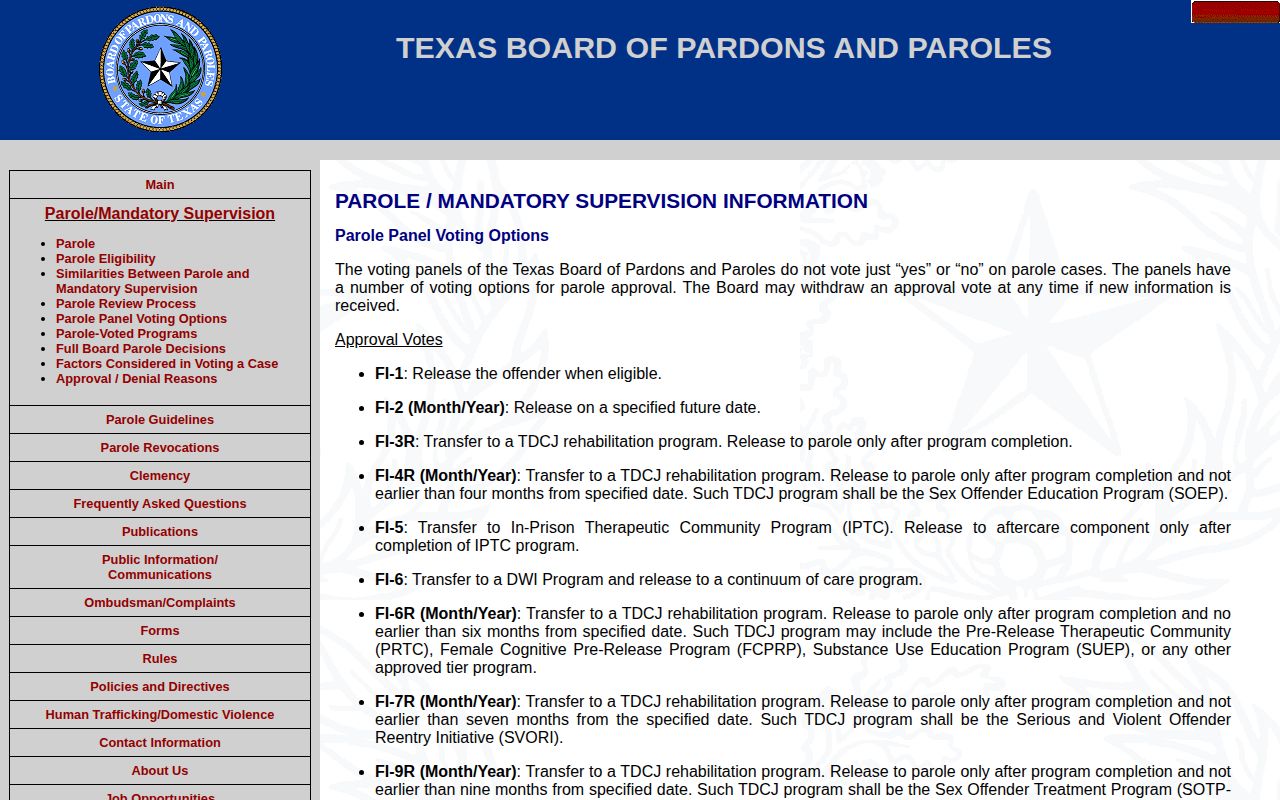
The Board vote-options page distinguishes decisions. FI variants can authorize release subject to conditions. RMS supports mandatory supervision. NR denies parole and sets a later review month and year. SA means serve all, subject to any legally earlier mandatory-supervision route. DMS denies mandatory supervision and can set a later review.
The official vote-options display shows why a short code must be read before making a date claim.
Government Code section 508.149 lists mandatory-supervision exclusions and discretionary review. A projected date for a post-1996 eligible offense may depend on Board approval, so it should never be copied into a statement that the person has already been released.
Bexar County Jail Uses Actual Timestamps
The BCSO daily release CSV is a county-jail product, not a projected-date calculator. It contains a release date and release time after processing, along with SO number, case number, court, attorney, release type, offense details, and bond fields. One dated file represents the honest daily source; the county does not call it a live rolling release application.
Open the Jail Activity Reports page and select the relevant release date. Seven dated links are kept online, and data may lag during booking processing. If the date has aged out, request the record from BCSO Central Records or use the 210-335-6201 jail information line. The Texas retention schedule keeps the jail register permanently and booking or release files generally for release or transfer plus two years.
A court release order supplies legal authority but can precede physical book-out when another charge or hold remains. A BCSO timestamp is the stronger evidence of the county exit. A transfer notation may mean the person moved to another agency rather than into the community.
Find a Date After TDCJ Release
Email pia@tdcj.texas.gov. Put the person's name in the subject and provide the full name and seven-digit TDCJ number. If that number is unknown, give exact date of birth, or approximate age and county of conviction. Ask specifically for incarceration history, actual release or discharge date, status, and mechanism.
TDCJ describes this listed-information email service as no charge, but it does not promise every historical field or a particular response time. It will not provide photographs or Social Security numbers through that channel. If email does not yield the existing record, submit a Texas Public Information Act request. For a parole decision, use the BPP status line as a separate source.
Federal and ICE Date Boundaries
The BOP Inmate Locator covers federal inmates from 1982 forward. It can display name, register number, release date, and location. A “Released” or “Not in BOP Custody” result confirms only that BOP no longer holds the person. Dates may change with First Step Act recalculation, and a residential reentry center or home confinement can remain BOP custody.
ICE says its locator includes people currently detained and those released from ICE custody within about 60 days. A Bexar County release can lead directly to ICE custody under a detainer, so the county timestamp does not always establish community release. Use the county transfer notation, then the ICE locator, then DRIL at 1-888-351-4024.
Read Court and Custody Dates Together
A Bexar judgment explains the sentence, but the custodian documents when custody ends. For a misdemeanor, use the County Clerk; for a felony, use the District Clerk and Justice Information Portal. Look for the judgment, jail-credit entries, later corrections, release orders, and warrants. A time-served judgment may explain why release became authorized without supplying the final book-out minute.
Label each milestone and source: eligibility from the TDCJ calculation, Board vote from BPP, processing information from TDCJ, and actual departure from the release record. If a detainer redirects the person, record the county or state release and the receiving agency's custody as consecutive events. This method makes later changes traceable.
For older material, request existing records rather than a hypothetical calculation. Include full name, birth date, TDCJ or SID number, county of conviction, and approximate custody dates. Precise identifiers keep the response tied to the correct sentence.
Confirm the Actual Bexar Release
Save the projected date with the date it was observed, because later calculations can supersede it. Then obtain the event record from the agency that held custody. For TDCJ, that is the release or discharge history. For BCSO, it is the release timestamp and type. For a court explanation, use the Bexar County Clerk for misdemeanors or District Clerk for felonies.
Do not merge eligibility, favorable vote, scheduled processing, and physical departure into one date. Keeping those milestones separate produces a record that remains understandable even if credits, Board action, holds, or transfers change the outcome.