
Applewhite Program Departure Paths
Applewhite Recovery Center at 10975 Applewhite Road contains residential programs associated with the Bexar County Community Supervision and Corrections Department. TDCJ's Community Justice Assistance Division lists a Substance Abuse Treatment Facility, an Intermediate Sanction Facility, and a Dual Diagnosis Residential Facility at the site. These are correctional-supervision programs. They are not the Adult Detention Center and they are not Dominguez Unit.
A person can leave Applewhite after completing a residential phase and remain on community supervision in Bexar County. Another person may be moved under a court or supervision plan, returned for a hearing, or taken into custody after an alleged violation. The departure must be read with the sentencing court's orders and CSCD's case status. The BCSO daily release CSV records county jail bookings, not routine exits from an Applewhite residential program.
| Applewhite event | Likely meaning | Confirmation source |
|---|---|---|
| Program completion | Residential phase ends | CSCD and court order |
| Step-down placement | Supervision continues elsewhere | Assigned CSCD officer |
| Court modification | Conditions change by order | Sentencing docket |
| Custody transfer | Possible jail or other agency custody | Receiving agency record |
Confirm an Applewhite Departure
No public Applewhite resident roster or recent-release feed was documented. Verification begins with the Bexar criminal case because probation, formally called community supervision, is imposed and changed by a court. The Justice Information Portal can lead to public case events, judgments, and orders. CSCD then supplies the supervision route to the extent information can be released.
- Identify the sentencing case and decide whether it is a felony or misdemeanor matter.
- Search the person's case and review the latest public judgment, modification, or revocation event.
- Contact Bexar County CSCD with the full name, case number, and sentencing court.
- Ask whether the residential phase ended and whether community-supervision conditions continue.
- If custody followed the departure, check the receiving jail, TDCJ, federal, or immigration system.
The Bexar County released inmate search covers the separate agency checks when the record points to custody rather than a community placement.
Note: Leaving an Applewhite program is a supervision event and does not, without a court record, prove that probation ended.
Applewhite Records and Contact
The state residential-facility list places the Applewhite programs at the same South Bexar County address. It does not publish a dedicated public Applewhite resident-status line in the researched material. Direct status questions to Bexar County CSCD, which administers county community supervision and works with the sentencing courts.
Applewhite Recovery Center residential programs10975 Applewhite Road
San Antonio, Texas
Bexar County CSCD
207 North Comal Street
San Antonio, TX 78207
Phone: 210-335-7200
Monday through Friday, 8 a.m. to 5 p.m.
Have the person's full name, date of birth, case number, and court ready. Ask a narrow question about the recorded program or supervision event. Staff may be limited in what they can disclose. The public court docket remains the best way to establish an order that placed the person at Applewhite, changed the terms, continued supervision, or revoked probation.
Applewhite Residential Program Types
The TDCJ Community Justice Assistance Division list identifies three types of residential programming at Applewhite. The Substance Abuse Treatment Facility includes female and male capacity. The Intermediate Sanction Facility provides a residential correctional response within supervision. The Dual Diagnosis Residential Facility addresses a program population with both substance-use and mental-health treatment needs.
Those labels describe program purpose, not a public custody status for a named person. A resident may be under a court's probation order while living at Applewhite. Community supervision generally permits a person to remain in the community under conditions, although a residential condition is more restrictive than ordinary office reporting. The precise order and case history control.
- Community supervision
- The Texas court term commonly called probation, with conditions set by the sentencing court.
- Intermediate sanction
- A structured response within supervision that may use a residential placement.
- Dual diagnosis
- Treatment addressing both substance-use and mental-health needs.
- Revocation
- A court action ending probation and imposing another lawful outcome after required proceedings.
Applewhite Court Record Search
Bexar County divides criminal court records by offense level. The County Clerk maintains misdemeanor criminal records. The District Clerk is custodian of felony criminal court records. Start with the Justice Information Portal, then route a copy request to the correct clerk. A case number is more reliable than a name alone.
| Record source | What to look for | What it may establish |
|---|---|---|
| Judgment | Sentence and original conditions | Whether community supervision was ordered |
| Modification order | Changed supervision terms | Residential placement or later step-down |
| Motion and hearing entry | Alleged violation process | Why the case returned to court |
| Revocation order | Final court ruling | Whether supervision ended through revocation |
The docket can establish legal action, but it may not show the exact hour a resident left Applewhite. CSCD records can address the program chronology. Ask for existing dates and status entries rather than an interpretation of why a person departed.
Applewhite Probation Status Boundaries
Probation is not parole. Bexar County CSCD supervises probation imposed by a Bexar court. TDCJ Parole Division supervises people released from Texas prison on parole or mandatory supervision. The Texas Board of Pardons and Paroles decides state-prison release matters. None of those Board functions controls an ordinary Applewhite probation placement.
Pretrial release is also different. Bexar Pretrial Services supervises some people released on personal recognizance or conditional surety while a criminal case remains pending. Applewhite's documented residential programs are linked to county community corrections. If the court record shows only bond conditions and no sentence, contact Pretrial Services rather than assuming a CSCD residential case.
No public statewide probationer locator was found. The correct chain is local: sentencing docket, correct clerk, and Bexar CSCD. A missing name from a jail roster does not fill that gap. Current jail rosters answer who is detained now, not who remains subject to a community-supervision order.
Note: Probation, parole, and pretrial supervision use different offices even when all three people live in Bexar County.
After Applewhite Residential Treatment
Completion of residential treatment can be one stage in a longer court plan. Conditions may still require reporting, treatment, testing, payments, or other acts stated in the court order. Only the case record and CSCD can show which terms apply to a particular person. A graduation, transport, or planned departure is not the same as discharge from community supervision.
Bexar County's Reentry Center services offer purpose-neutral help near the justice complex. The official services page shown below documents support available after a residential phase.
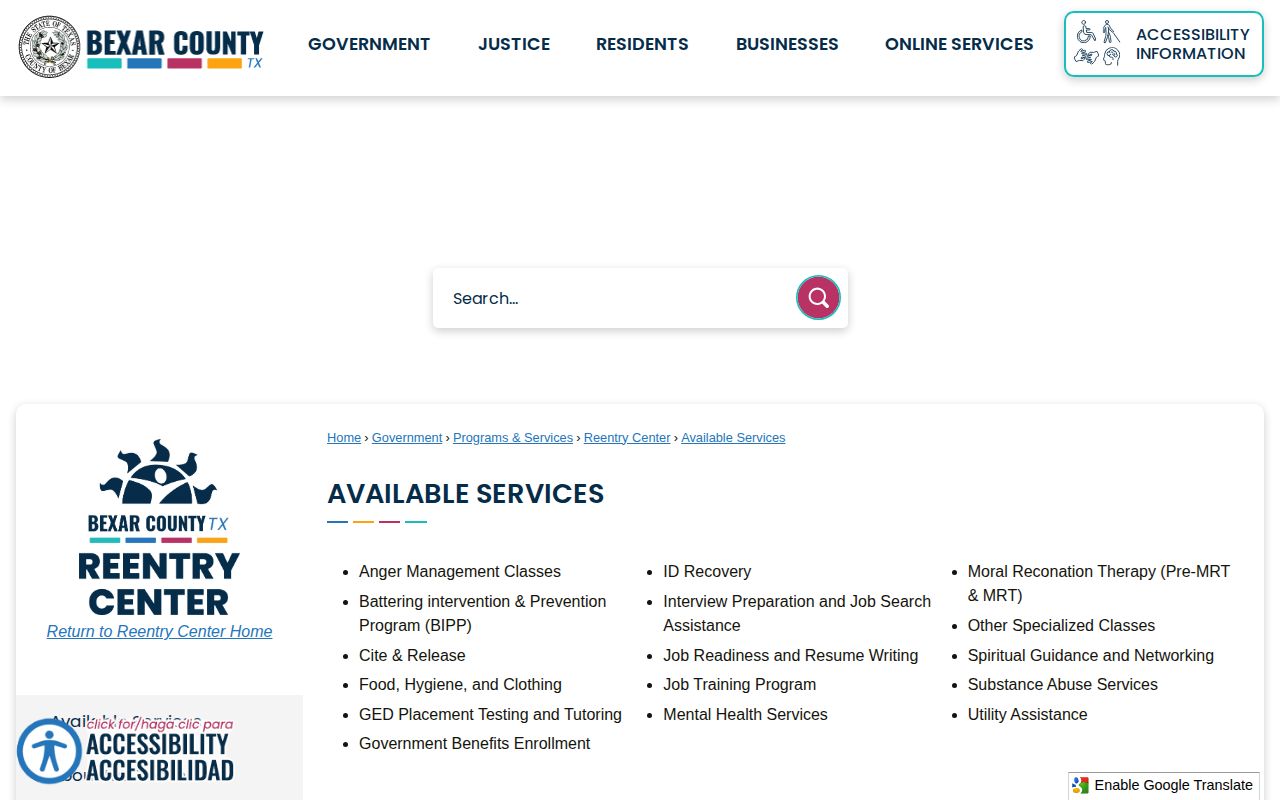
The listed support includes identification recovery, food, hygiene items, clothing, benefits navigation, behavioral-health support, utilities, education, and Cite & Release assistance. The directory main line is 210-335-8281, while the services narrative separately prints 210-335-8744. These resources do not verify an Applewhite case, but they may help someone handle practical needs after a residential phase.
The reentry resource is separate from CSCD supervision. A support referral does not alter a court condition. Keep program help, legal status, and records verification in distinct channels so a service contact is not mistaken for proof that the case closed.
Applewhite Transfers and New Custody
Some departures lead to another controlled setting. If an alleged violation results in arrest, check the Bexar County jail system and the court docket. If a state-prison sentence follows revocation, use TDCJ Offender Information. Federal and immigration systems become relevant only when the case record or receiving agency documents that jurisdiction.
A Bexar jail release can also lead to continued federal custody. ICE describes a detainer as a request for notice and up to 48 additional hours so federal immigration officers can assume custody. That scenario should not be inferred merely because an Applewhite resident disappears from contact. Use the ICE Online Detainee Locator only when immigration custody is supported by identifying facts or the record.
The same rule applies to state prison. Dominguez Unit is a TDCJ prison in Bexar County, but Applewhite is not a feeder roster for Dominguez. A court judgment or receiving TDCJ record must show the custody change. Physical proximity and county location do not prove transfer.
Applewhite Record Request Details
A useful request identifies one person and one supervision period. Include the exact name, date of birth, cause or case number, sentencing court, approximate Applewhite entry and departure dates, and the type of record sought. Ask for recorded admission, transfer, completion, discharge, or termination dates that can lawfully be released. Avoid a broad request for every treatment detail.
Public access has limits. Treatment, medical, mental-health, victim, sealed, juvenile, and other protected material may be withheld or redacted. The absence of a confidential program note from a public response does not show that the event never occurred. A clerk can provide public court documents, while CSCD controls its own supervision records.
If the online docket is unclear, request the judgment and later orders from the proper clerk. For a felony, use the District Clerk Criminal Division. For a misdemeanor, use the County Clerk Criminal Division. Compare the signed orders by date. A later modification can replace or refine an earlier placement condition.
Applewhite Departure Evidence
Reliable verification joins three facts. First, the sentencing record shows why community supervision exists. Second, CSCD identifies the supervision and residential-program chronology to the extent public law permits. Third, later court entries show whether the judge continued, modified, completed, or revoked the order. No recent-inmate feed combines those facts.
Date each event. A person can complete an Applewhite phase and remain on probation. A later warrant or revocation proceeding does not erase that earlier completion. Conversely, leaving the grounds does not establish successful completion when a transfer or alleged violation followed. The next official record supplies the context.
The correct wording is often “departed the residential program” or “completed the residential phase,” not “released from jail.” Applewhite serves community corrections. Using the right terms prevents a treatment placement from being described as incarceration and keeps a continuing court obligation from being mistaken for a finished sentence.
Public Record Search
Sponsored Results